Fault detection use case · Model predictive control
How Buildwise traced the root cause of its recurring heat-pump faults and quantified the influence of solar gains on its most exposed façades — using Builtwins predictive control on a physics-based digital twin.
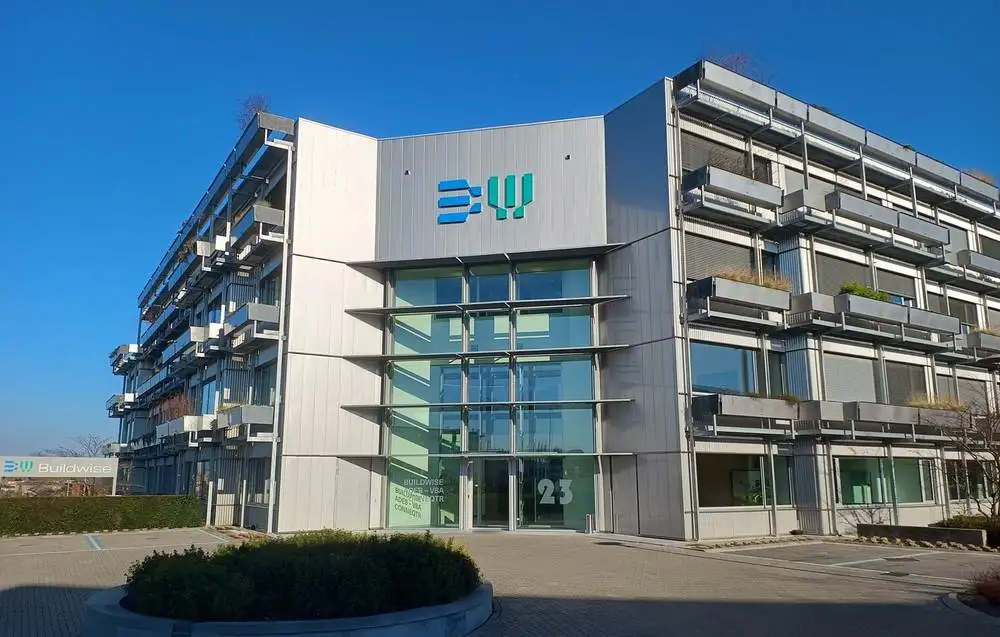
Buildwise HQ, Zaventem — 10,000 m², geothermal heat pumps, MPC + excitation tests
A 10,000 m² office building over four above-ground floors, with meeting rooms, open-plan offices, a restaurant, a large atrium and two levels of underground parking. Heating and cooling come from two geothermal heat pumps — a third serves domestic hot water — all connected to a shared borehole field, distributed via three air handling units, radiant ceilings, fan coil units and VAV boxes.
Before Builtwins and Sweco took over HVAC control, the three heat pumps were frequently in alarm and the underlying cause was unclear. The initial studies had also not revealed the particular behaviour of the zones located on the two most sun-exposed façades and the impact on their sensor measurements. Conventional control follows fixed rules, treats each system as a separate island, and offers little insight into why a building overconsumes.
Builtwins goes beyond monitoring. We build a physics-based digital twin of the building — modelling production, emission and ventilation together across every zone — and run Model Predictive Control on top of it, supported by excitation tests. At Buildwise, this pinpointed the heat-pump fault so the installer, control company and manufacturer could resolve it, while the MPC made it possible to objectify and quantify the influence of solar gains, so the control could be adapted to improve both comfort and the building’s energy performance. Additional wireless (LoRa) CO₂-and-temperature sensors extended zone coverage cost-effectively and improved BACS compliance.
A digital twin built from floor plans, HVAC installation and sensors, zone by zone.
Weather, solar radiation, and the building's own thermal response are anticipated per zone — not just today's temperature.
Energy minimised within comfort limits (temperature, CO₂); re-run every 15 minutes.
Anomalies surfaced automatically, so maintenance acts on the faults that matter most.
Heating, ventilation and cooling drive a large share of a building's energy use — yet most systems are still steered by fixed rules that ignore how the building actually behaves. A digital-twin approach moves beyond dashboards: it reveals the real levers of optimisation, turns technical data into decisions, and helps owners meet tightening energy and ESG requirements.

Let's turn your HVAC data into measurable savings.
Talk to Builtwins →info@builtwins.com | www.builtwins.com