Energy savings use case · Model predictive control
How Herman Teirlinck uses Builtwins Model Predictive Control and a physics-based digital twin to cut energy use across 52,000 m² without compromising comfort.
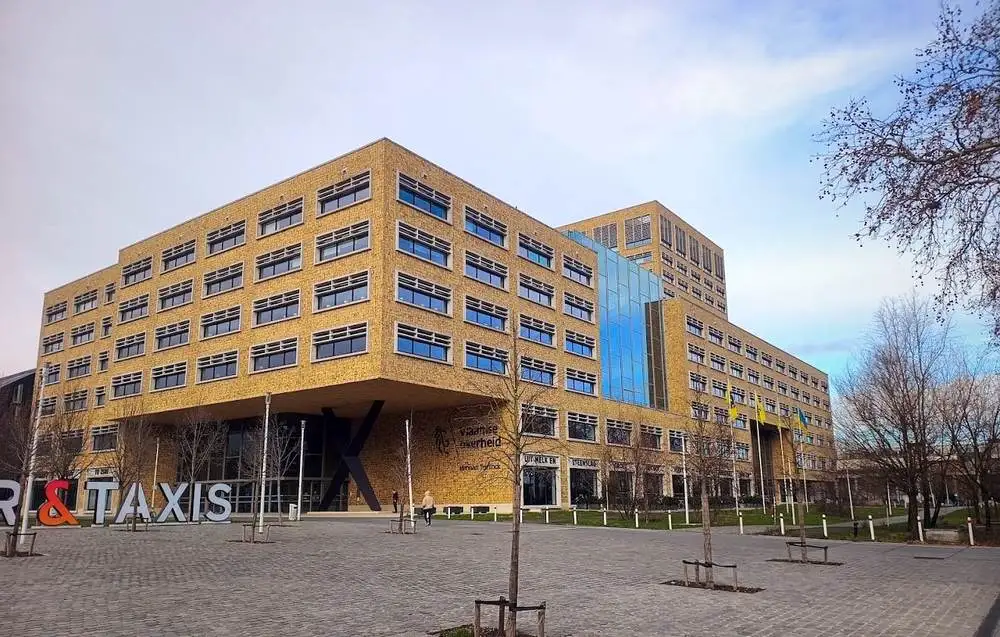
Herman Teirlinck, Brussels — 52,000 m², ATES + concrete core activation, MPC + excitation tests
A 52,000 m² office building over 14 above-ground floors with two underground parking levels, mixing open-plan offices, meeting rooms, auditoriums, a restaurant and an indoor street — designed to a very high standard of energy efficiency (passive building). Heating and cooling come from geothermal energy via an Aquifer Thermal Energy Storage (ATES) system connected to concrete core activation with room-level control; most rooms add VAV boxes and heating coils, with ventilation from air handling units with adiabatic cooling.
The first challenge is the sheer number of HVAC actuators: more than 600 rooms, nearly every one with its own temperature, humidity and CO₂ sensors plus a VAV box, a heating coil and a valve controlling its concrete core activation circuit. The second is the building’s substantial thermal inertia from its activated concrete floors, which fixed-rule control cannot anticipate.
Builtwins goes beyond monitoring. We build a physics-based digital twin of the building — modelling production, emission and ventilation together across every zone — and run Model Predictive Control on top of it. For Herman Teirlinck, Builtwins and Sweco developed a dedicated excitation-test methodology that lets the MPC test every single actuator and sensor of the emission system overnight, detecting anomalies in 24% of them and helping resolve them. By anticipating heating and cooling needs from weather forecasts, MPC cut the heat pump’s energy use by around 38%.
A digital twin built from floor plans, HVAC installation and sensors, zone by zone.
Weather, solar radiation, and the building's own thermal response are anticipated per zone — not just today's temperature.
Energy minimised within comfort limits (temperature, CO₂); re-run every 15 minutes.
Anomalies surfaced automatically, so maintenance acts on the faults that matter most.
Heating, ventilation and cooling drive a large share of a building's energy use — yet most systems are still steered by fixed rules that ignore how the building actually behaves. A digital-twin approach moves beyond dashboards: it reveals the real levers of optimisation, turns technical data into decisions, and helps owners meet tightening energy and ESG requirements.

Let's turn your HVAC data into measurable savings.
Talk to Builtwins →info@builtwins.com | www.builtwins.com